So if you are thinking that I am a slug then you would be
correct in your assumption. I have been
so delayed in updating this blog that some might have thought that I had met
with an unfortunate accident rendering my typing fingers useless. Rest assured, I have met with no such
events and I am back! Okay, enough of
that and I hope that you all do accept my apologies as I know you have all been
waiting to exhale and read the latest updates on this epic journey.
 |
| The mooring field in Neiafu Harbor, Vava'u, Tonga. |
Tonga. Many things
happened in Tonga; some good and some not so good. To begin with, Tonga, specifically the Vava’u
Island group, was beautiful. The town of
Neiafu, situated on a large open harbor, was just big enough to entice me to
wander the streets and meet the locals and palangi
(the Tongan word for foreigners). I made
numerous friends during our stay in Tonga; many I will never forget for their
kindness. It was also great to catch up
with many of the other boats we had traveled far and wide with along the way
from Mexico and through the South Pacific.
It’s amazing that you can go weeks or even months without seeing these
friends and suddenly they are anchored right next to you and you just pick up
where you left off; no questions, just tales of other places visited by other
boats. So a big shout out to all those
boats and friends who made our stay in Tonga a memorable one.
The outer islands in the Vava’u Island group are quite
beautiful. Tracts of untouched tropical
lushness growing right up to the sable colored sandy beaches, clear blue water
and unspoiled coral gardens scattered through over forty separate islands in
this boater’s paradise. We visited a
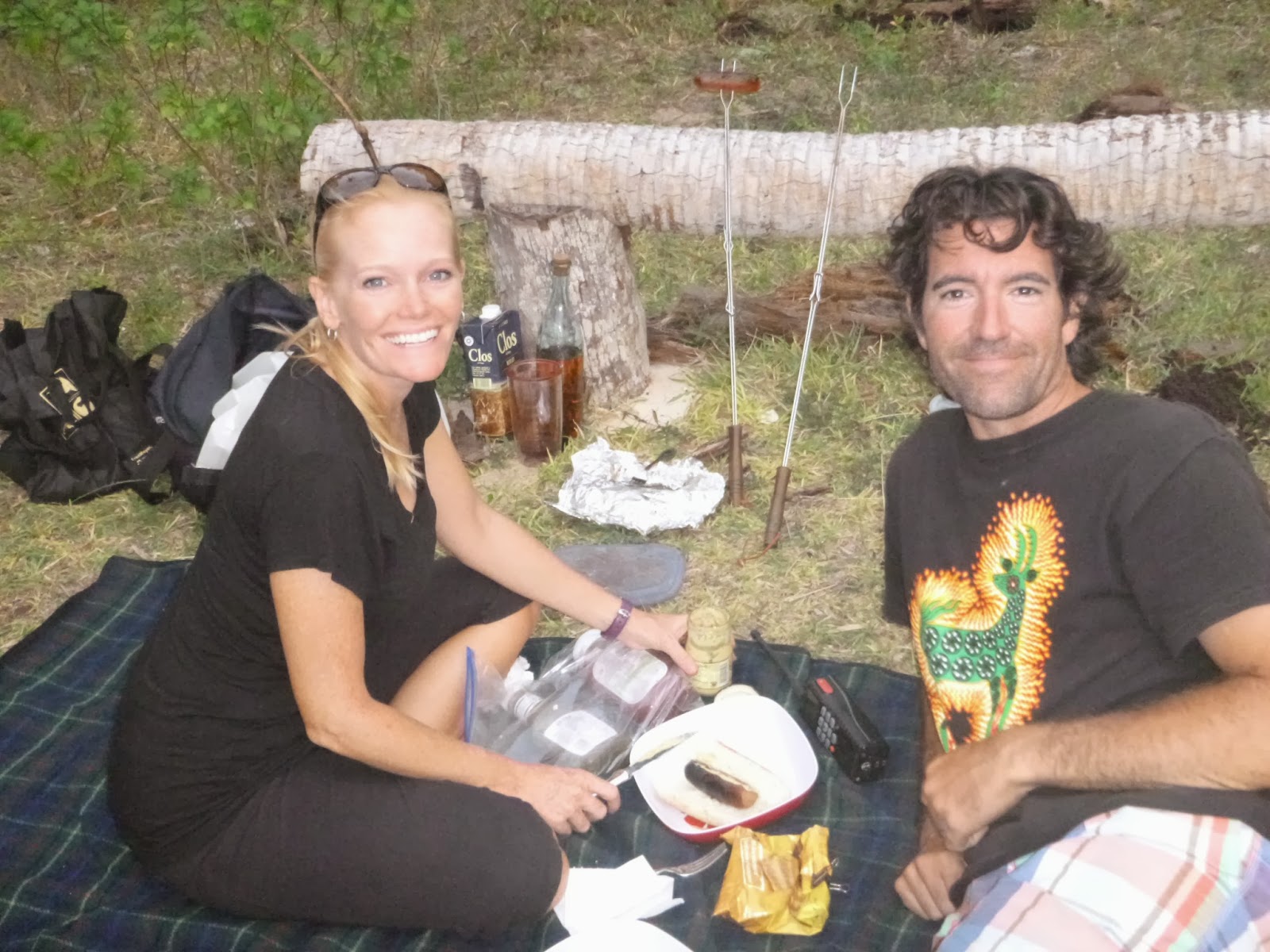
handful of these islands and shared beach bonfire potlucks, hikes, and
snorkeling adventures with our friends and watched the sun set over one or
another of the green islands. Truly a
feast for the senses. Indeed, the colors, sounds and smells of Tonga are intoxicating.
 |
| Our Lape Island hosts for the Tongan feast. |
On Lape Island (pronounced "la-pay"),
the locals put on a traditional Tongan feast and Richard and I and about 35
other yachties partook in the festivities which included a tour of the small
village (there are only about 40 people living on Lape), listening to the
traditional Tongan feast songs, and then enjoying a pig cooked in an umu (underground oven) complete with
Tongan side dishes. The announcement for
the feast is given a week in advance on the cruiser’s net broadcasted over the
VHF. As part of the announcement,
Kohelo, the unofficial ambassador for the island, stated that entertainment
would be provide by the Village People so naturally we expected to see a
construction worker, policeman, etc., etc.
But no, the entertainment was provided by the people of the
village. Ha! So no “Y-M-C-A”; instead we got “L-A-P-E”! In any event, a great time was had by all.
 |
| The idyllic location for the Tongan feast on Lape Island. |
The feast is by donation and the village uses the donations
to help keep up the island. In a previous
year, they used the money to build a dock so that cruisers could visit the
island. Their current project is to
purchase a proper working toilet.
Apparently the children on Lape travel to Neiafu for school and are
embarrassed because they do not know how to work a flushing toilet. In some cases, they are inadvertently
breaking the school toilets. We take so
much for granted in our first world nations and a flushing toilet is certainly
one of them. More on toilets later.
The next morning, a couple of us cruisers dinghied to shore
and delivered school supplies to the local teacher. I also gave Kohelo a fishing pole and other fishing supplies for which he was very grateful.
 |
| Me, Jeanne and Cole. |
I would be remiss if I didn’t give a shout out to Jeanne and
Cole of s/v Divided Sky who were kind
enough to take the crews of Osprey, Calico Jack, and Gallinago to Mariner’s Cave and the Coral Gardens on their
boat. It would have been impossible to
dinghy to Mariner’s Cave and you can’t just drop the hook outside the cave and
swim on over due to the steep drop off outside of the cave’s entrance. So the eight of us headed out one morning and
with Jeanne and Cole on their boat stationed close to shore, the rest of us
donned our snorkeling gear and swam over to the cave. To get into the cave you have to swim down
about four meters and then swim straight ahead for another seven to ten meters,
then up another three or four meters before surfacing in the cave. The cave itself is pretty big, about ten meters
in diameter and ten meters to the roof from the surface of the water. It’s also deep inside the cave and there were
schools of fish swimming in there with us.
 |
Lunch on s/v Divided Sky after snorkeling in
Mariner's Cave. |
After exploring the cave we headed back to the boat for a
potluck lunch and then we were off to the Coral Gardens. The Coral Gardens are a large tract of
unspoiled living coral in every hue of the rainbow. The gardens consist of canyons that you can
dive into and swim along, all the while watching colorful fish, and octopi!,
swimming along the walls of the canyons.
Finding Nemo was easy in this unspeakably beautiful area. Nemo is actually a specie of clownfish or
anemonefish, and comes in a variety of different color combinations.
 |
| Fiesty Clownfish. |
These guys are feisty too! When you get close to them they dart out from
their homes and a couple of them actually came right up to the GoPro camera in
a threatening manner. They live among
the anemone and are immune to the stinging tentacles. The clownfish have a symbiotic relationship
with the anemone in that they preen the anemone and drive off predators, and the anemone provide protection for the clownfish and their young
because other predator fish are not immune to the anemone’s toxins and know to
steer clear.
The entire time we were snorkeling in the cave and at the
coral gardens we could hear humpback whales singing. We didn’t see the whales, but their songs were so loud that I was able to capture their singing on my GoPro underwater camera
even though it is housed in a plastic casing.
So thanks again Jeanne and Cole!
 |
| The Kava Master serving it up fakatongan (Tongan-style). |
During one of our beach bonfire potlucks, and while
celebrating Kyra's birthday (from s/v Nyon), we drank kava. Kava is a root that once dried, is ground
into a fine powder, mixed with water and served, ceremoniously, from a bucket
using a half coconut shell as a cup. I
scored some kava in town and once we had finished eating birthday cake, I put the
concoction together. You place the
ground kava in cheesecloth or some other fabric to make a giant teabag that you
then dunk in the water exactly like you would if you were making a cup of
tea. Once the kava has steeped long
enough, stirring constantly, you serve up the grog in the coconut
shell. I was the kava-master that
evening and tried as best as I could to respect the kava culture by offering the
kava to each individual in the same order as we went round and round the
group. Of course, because it was Kyra’s
birthday, she went first followed by the rest of the group (there were ten of
us) and then I had my cup.
 |
| The Kava Circle at Kyra's birthday party on the beach. |
Kava is nasty
tasting; some say it tastes like dirty dishwater which it strongly resembles,
others say dirty socks. Either way,
you’re not going to like the taste necessarily but the intoxicating effects are
quite sublime. It’s not like
alcohol. It starts with a numb feeling in
your lips and mouth and for the most part that’s about it until you reach a
certain threshold. Once you are there,
and it depends on how strong the kava has been brewed, a calmness overtakes you
and you are suddenly feeling very chilled out. This relaxing feeling lasted through the next
day for me and was actually recognized by others who commented on how quiet and
calm I was the next night (and for those who don’t really know me, quiet and
calm are not characteristics typically associated with me). There are more elaborate kava ceremonies
throughout the South Pacific with the kava supposedly getting stronger and
stronger the further west you go. I also
hit the local kava circles in town with some other palangis and had the opportunity to experience a typical kava
circle which is predominantly men only.
Women can stir the kava but are not usually invited to partake except in
the touristy kava ceremonies or in situations like ours on the beach. But hey, gals, at least they let you stir the kava...LOL! Oh yea, kava is legal.
 |
Local school marching band celebrating something.
Tongans really get into marching bands; especially
for funerals which seem to occur weekly. |
So toilets. Yea,
toilets. Can’t live without them and if
the one on your boat is out of order, it definitely curbs your cruising. Ours stopped working due to calcification in
the hoses that carry…well, you know, from the toilet to the holding tank. Richard worked for many, many days pouring
chemicals (acids) into the hoses, letting them sit and then siphoning them only
to repeat the whole process hundreds of times.
And then, just when we had decent “flow” Richard noticed a leak in the
apparatus that was too big to ignore. He
ordered a replacement that had to come from Auckland, New Zealand and that took
quite a long time while we waited patiently, or not so patiently, in Neiafu
harbor. You really can’t go anywhere
where there isn’t a working toilet and I am no bucket boy, so that option was
out, and we waited for the part to arrive while other boats explored many more
islands than we got to. Oh well.
 |
| Stephen and Carl, owners of the Poolside Cafe in Vava'u. |
I spent a lot of time at the Poolside Café and got to know the owners, Stephen and Carl, the
chef, Mary, and the girls who worked the kitchen. Stephen and Carl hail from Ottawa and opened
this business a few years ago. Mary is amazing in
the kitchen. Her take on traditional
Asian, Canadian, and Italian dishes is remarkable. Poolside Café boasts the best poutine in the South
Pacific and having tried it, several times, I would have to agree. From nasigoreng to arancini, Reuben
sandwiches to creamy mushroom risotto, Mary can do it all. And don’t even let me start going on and on
about her homemade spicy Italian sausages!
Unbelievable! Ask for it in the
Eggs Benedict dish with Hollandaise sauce and she will probably ask if you know
me as I ate that several times and thoroughly enjoyed every artery clogging
bite of it! Hats off and spoons up to
Mary and her girls in the kitchen for providing the most interesting, delicious
and globetrotting cuisine in Neiafu.
 |
Connolly and me (with Mary in the background)
working the bar at Poolside Cafe in Neiafu,Tonga. |
On a couple of occasions I got to work behind the bar with my mate Connolly and we each earned ourselves a coveted Poolside Cafe staff shirt which we both wear proudly. Who knew that slinging beers and mixing cocktails could be so fun? While we may have lacked the moves of Tom Cruise in the movie Cocktail, I think we made up for it in spunk and smokin' good looks. Ha! For those of you are worried about what I'm going to do for work when I get back to the States, let's just say that I have added bartender and bar manager to my resume so we'll see if that pans out for me!
 |
Brian is not only the fakaleiti show emcee,
she was also a sweetheart that I got to know. |
Fakaleitis are basically the Tongan equivalents of drag queens and provide a rowdy source of entertainment in Neiafu at a bar called Motele on the old harbor. We spent several evenings with friends watching their shows and dancing the night away. Everyone walks out to the bar from town along dirt roads with pigs and chickens everywhere (yes, they roam free everywhere in Tonga). All I can think about when I see these animals running around is what lovely entrees they would make! Anyhow, the show doesn't start until around 10 PM and you get a free drink with the price of admission which is only $5 pa'anaga. The more you clap, shout and cheer the fakaleitis on, the better the show gets so make sure you have plenty of pa'anaga, tip liberally, and hoot it up like you just don't care! After the show, a DJ spins music till the wee hours and everyone, cruisers and locals, and of course the fakaleitis, dances the night away.
For the first time ever, Osprey
raced in the Vava’u Regatta. The
weeklong festivities involved a dressed up pub crawl, a cornhole tournament (I
know, it sounds naughty but it’s basically tossing bean bags around and trying
to land them through a hole cut out of a board ten meters away), and two days of
races separated by a white party on the beach and resort of a tiny island.
 |
Osprey crossing the finish line in the
Vava'u Regatta 2013. |
So this is how the race that we entered went. Having never raced before we had no clue on
how to properly jockey for a position close to the starting line without
ramming into any of the other boats. So
we hung back and when the horn rang to start the race, we were way in the back
of the field. We actually crossed the
start line last and a full five minutes after the last boat had crossed the
line. Not to be put off, we sluggishly
made our way out of the harbor and came upon the second to last boat in the
pack. We smoked by them at a whopping
1.something knots and I turned to Richard and said, “See that Halberg Rassey up
ahead? Their next! Let’s catch them!” So at a blistering 2.something knots, we
overcame the HR and left them wallowing in our wake. HaHa!
Racing is fun! We ended up
passing six boats in total, our speed eventually rose to a very respectable
6.something knots, and we saved our dignity by not coming in last…which was our
only goal of the day. We consider
ourselves having come in “first in class” because we were one of only two
Island Packets and we beat them despite their boat being bigger. With Richard deftly at the helm and me
handling the lines, who knows, maybe we missed our calling and should have been
bluewater racers.
 |
From left to right: Seleni (jellyfish), Carl (zombie chef),
me (King Neptune), Mary (Queen of Tarts),
Stephen (gladiator), and Richard (cowboy with blue steer). |
While lots of other cruisers left for Fiji and beyond, we
remained in Tonga waiting for our toilet part to arrive. The good news was we got to spend Halloween
in Tonga. The Aquarium Café throws a raucous Halloween party and most of the
cruisers who were still in Neiafu attended as well as many locals and palangi.
I met up with Mary, Stephen, Carl and Seleni at Mary’s house where we
prepped for the party. Once we were all
ready, we piled into a truck and drove to the party. To really experience Tonga you have to ride
in the back of a truck, standing up and holding on, counting the pigs on the
side of the road, as you drive from one place to another. Mary got to sit in the front because she had
a pie strapped to her head and a ball gown on as part of her costume (she was
“Mary, Queen of Tarts!”). The party was
a big hit and it seemed like all in attendance had a great time.
With our toilet finally fixed, we left Tonga and headed to
New Zealand…but that’s another story for another day!
More pics of our time in Tonga…enjoy!
 |
| This one's for you Nicole! Angel the bar pig. |
 |
Tongan Pig Roast.
Rest assured, neither of those pigs are Angel! |
 |
| The booby and me. |
 |
| Traditional Togan outrigger. |
 |
| They are EVERYWHERE! Even on the beaches! |
 |
Adam believes that a machete makes a great pizza
slicer and Aaron doesn't seem to mind or disagree. |
 |
| The lovely, lovely vegetable market in Neiafu (inside joke). |
 |
| Entrance to Swallow's Cave. |
 |
| Dinghies inside Swallow's Cave. |
 |
| Me and Richard celebrating one year at sea. |
 |
| WE DID NOT COME IN LAST!!! |
 |
| Potluck on the beach Tongan style. |
 |
| Nicole and Aaron of s/v Bella Star relaxing at the potluck. |
 |
| Joanne and Travis of s/v Calico Jack about to dig in. |
 |
| Idyllic, secluded beach in the Vava'u Group, Tonga. |
 |
Baby goat on Lape Island. No! I did not think
about how tasty he would be on a skewer. |
 |
| Adorable little Lape Island girl. |
 |
| Tongan Feast on Lape Island served on a banana stock plate. |
 |
| I swear, Travis and Joanne do more than just eat! HA! |
 |
| I called this beach "Starfish Beach," can you guess why? |
 |
| Me, Stephen and Mary, up to no good. No good at all! |
 |
Local Tongan and me at the kava circle in Neiafu.
Not sure if you can tell, but I am SO mellow in this picture. |
 |
At a certain point on Halloween,
things began to spiral out of control. |
 |
Me, Richard and Connolloy.
Where's Richard's blue steer? |
 |
Ah Ha! And who might you be?
And why do you have Richard's blue steer? |
 |
| Tongan women are sweet but I wouldn't mess with them. |
 |
What happens in Tonga, stays in Tonga!
Unless you post it on the internet! Oops! |
 |
| Mary, me and Connolly watching the bar at Poolside Cafe. |
 |
| Rick and me at the fakaleiti show. |
 |
| The Girls, Nicole, Kyra and Joanne, are up to no good! |

Me and my peeps, Heidi and Joe of sv Huck.
|
|